A century ago, in a quiet field in Auburn, Massachusetts, a scientist named Robert Goddard changed the course of human history. With the world’s first successful launch of a liquid-fueled rocket, Goddard ignited the modern space age, transforming the sky from a distant ceiling into a reachable frontier.
To celebrate this momentous centennial, Worcester State University and the Museum of Worcester hosted an evening exploring the legacy of the man often called the “Father of Modern Rocketry.” The event, held on April 9 in the museum’s Fletcher Auditorium, featured Associate Professor of Physics and Astronomy Andrew Burkhardt as the guest speaker.
Andrew Burkhardt, assistant professor of physics at Worcester State and an expert in astrochemistry, spoke to a captivated audience about how Goddard’s revolutionary breakthrough paved the way for humanity to put scientific equipment – and eventually people – beyond the Earth’s surface.
While rockets had existed for nearly 2,000 years in the form of gunpowder-based projectiles, Burkhardt explained that Goddard’s genius lay in his move toward liquid fuel. Solid fuels like gunpowder simply didn’t offer enough “oomph” to escape Earth’s gravitational pull.
“The revolutionary thing he did was liquid fuel,” Burkhardt said during his presentation. “If you don’t have a powerful enough fuel source, you’ll never get to the point where you can actually accelerate up to the speeds you need to reach space.”
Goddard’s realization led to the March 16, 1926, launch, where he utilized a combination of liquid oxygen and kerosene. This shift in technology allowed for a much higher “specific impulse” – the efficiency with which a rocket uses its mass to create thrust.
Burkhardt said that while Goddard faced skepticism in his time, including a famously scathing editorial from the New York Times, his persistence was driven by a childhood fascination with other worlds. This determination eventually secured him support from figures like Charles Lindbergh and the Guggenheim family, allowing his research to flourish in the clear skies of Roswell, New Mexico, where he had moved to continue his experiments.
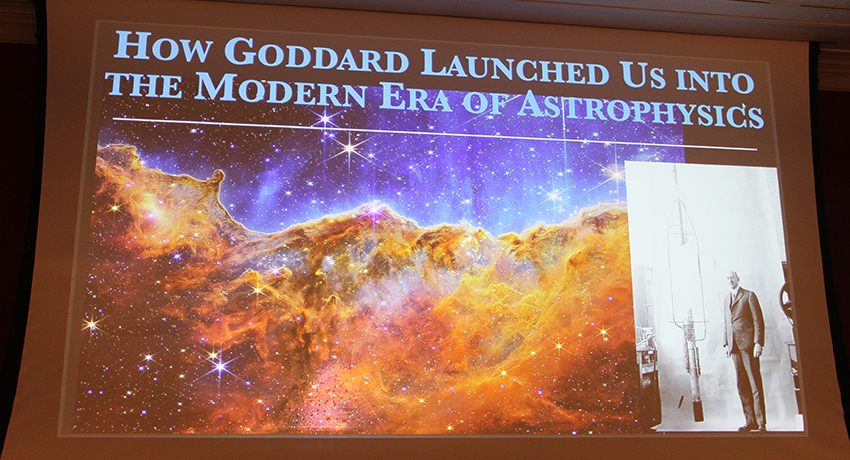
As an astronomer, Burkhardt said he often thinks about time and the specific moments that irrevocably change the universe. He compared Goddard’s launch to cosmic events like a supernova, where a star’s collapse leaves the world around it fundamentally different.
“Today I would like to propose that one of those events here was led by this kind of maverick of an individual, Robert Goddard,” Burkhardt told the crowd. “The ability to overcome that fuel barrier allows us as a humanity, as a civilization effectively, to now go beyond our own surface.”
A significant portion of Burkhardt’s talk focused on demystifying the physics of spaceflight. He addressed common misconceptions about weightlessness, explaining that astronauts on the International Space Station aren’t weightless because gravity is absent – they are actually in a constant state of free-fall.
“Flying is learning how to throw yourself at the ground and missing,” Burkhardt said, quoting author Douglas Adams to illustrate the concept of an orbit. “That is effectively what we do when we put things in space. We throw them so fast… that they actually just miss the ground constantly.”
By achieving these incredible speeds through liquid-fuel technology, humanity has been able to send probes to the acidic surface of Venus and rovers to the dusty plains of Mars – feats that were physically impossible before Goddard’s 1926 experiment.
The event served as a showcase for the deepening relationship between Worcester State University and the Museum of Worcester. This collaboration is part of a multi-faceted Memorandum of Understanding between the two institutions, driven by the university’s public history minor.
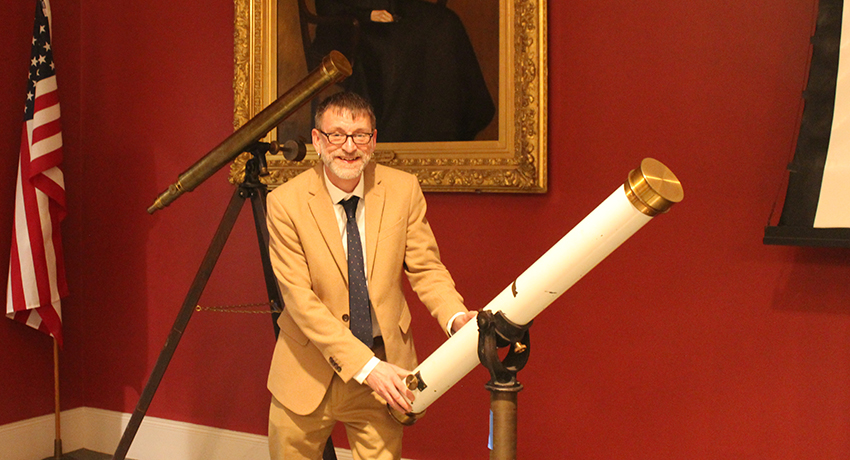
In addition to Burkhardt’s presentation, the university displayed a selection of antique telescopes from the Charles Blumsack collection. They were made by the former Alvan Clark Co. of Cambridgeport, Massachusetts, one of the premier makers of telescopes. These instruments, typically housed in the Ghosh Science and Technology Center, were loaned to the university by Charles’s widow, Cynthia Blumsack.
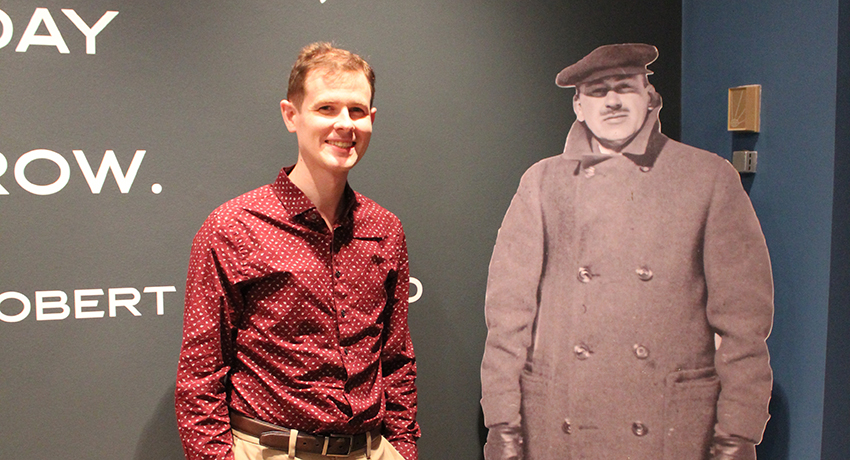
Following the talk, attendees were invited to tour the museum’s new Goddard exhibit, which features artifacts and images from NASA, The Smithsonian Institution, and other sources. The evening was a reminder that while Worcester State University is focused on the future of research, its roots are firmly planted in a region that helped launch the world into the stars.